

Precision cold laser vs multi-wavelength mask, compared.
JOVS 4D Laser Mask vs LYMA Laser is one of the most-searched comparisons in at-home skin tech. It comes down to the question people ask about LYMA Laser vs red light masks: is it a laser, and how is the light delivered? This comparison uses only information that is published and verifiable at the time of writing.
"We do not make unsubstantiated claims about the LYMA Laser and we work with some of the world's most renowned doctors, dermatologists and experts, all who have reviewed the LYMA Laser and credit the device for its ground-breaking technology," says LYMA founder Lucy Goff.
Which is better, JOVS or LYMA Laser?
Both devices sit in the at-home laser category, but they are built around opposite approaches. The LYMA Laser concentrates its full power through a single 1.24 sq in (8cm²) coherent lens, treating one area at a time. The JOVS 4D Laser Light Therapy Mask spreads its output across dozens of smaller diodes built into a wearable, full-face mask, prioritizing hands-free coverage over concentrated power.
The right choice depends on whether you want a shorter, higher-intensity, targeted protocol, or a longer, hands-free session that covers the whole face at once, and on what each device is cleared to do and how much independent evidence exists for it.
LYMA vs JOVS: the fundamentals
| LYMA Laser | JOVS 4D Laser Mask | |
|---|---|---|
| Type of laser technology | Concentrated single-beam laser | Distributed diode array: power divided across many points (four wavelengths) |
| How it works | Photobiomodulation via one large coherent treatment lens | Distributes laser energy across many smaller diodes in a full-face mask |
| Wavelength | 808nm, the middle of the 600–1000nm therapeutic optical window | 660nm, 850nm, 940nm and 1064nm across facial zones |
| Coverage | Handheld; a 1.24 sq in (8cm²) lens treats one area at a time | Full face only, all at once, hands-free |
| Light properties | Monochromatic (single 808nm wavelength), coherent and polarized | Four separate wavelengths, so not monochromatic as a system; polarization is not stated in JOVS's published specifications |
| Treatment scope | Designed to reduce the appearance of fine lines and wrinkles | Designed to improve the appearance of wrinkles |
| US regulatory status | FDA cleared (510(k)) for facial wrinkles | FDA cleared (510(k)), scoped to wrinkles |
| Scientific evidence | 50+ independent peer-reviewed papers on LLLT/PBM in general; [five] studies on the LYMA Laser published in the Aesthetic Surgery Journal (Oxford University Press); an independent clinical trial measured with a Cutometer showing a 103% increase in skin elasticity within 30 days [cite] | Testing data published by JOVS, which references third-party SGS testing; no peer-reviewed publication found at the time of writing |
| Consistency | Daily use for the first 12 weeks (one full skin cycle), then around 3 times a week to maintain | Daily use, with some changes reported by JOVS from around 28 days |
| Session time | From 3 minutes per treatment area, daily | Typically 10–20 minutes, daily |
| Portability | Handheld and cordless; can be used anywhere, anytime, while doing other things | Full-face mask tethered to a controller; used sitting or lying still |
| Price | [$ US price] | Around $849, depending on promotions [confirm] |
LYMA vs JOVS: the stats and technical specifications
Scientific proof: peer-reviewed research vs manufacturer-reported testing
More than fifty independent, peer-reviewed papers examine the biological effects of low-level laser therapy (LLLT) in general. The LYMA Laser itself has been the subject of [five: confirm and cite each] studies published in the Aesthetic Surgery Journal (Oxford University Press), including a study into gene expression in the dermis. An independent clinical trial measured with a Cutometer Dual MPA 580, an instrument used to assess skin elasticity in clinical settings, recorded a 103% increase in skin elasticity within 30 days [cite trial: sample size, duration, sponsor]. JOVS's published results, including its "week 1, week 2, week 4" improvement statistics, come from testing reported by JOVS. JOVS references third-party SGS testing, but we could find no peer-reviewed publication of its results at the time of writing.
Power and delivery: concentrated beam vs split output
The LYMA Laser concentrates a 500mW beam through one 1.24 sq in (8cm²) coherent, monochromatic, polarized lens. The JOVS mask spreads four wavelengths across many individual diode points on a wearable mask. Independent reviewers report its irradiance as approximately 143 mW/cm² [cite source; confirm whether measured or manufacturer-stated], which JOVS positions as higher than a typical LED mask (usually 20–50 mW/cm²).
Performance: whose wavelength sits in the therapeutic window?
The Therapeutic Optical Window is the wavelength range of 600–1000nm, the band in which, according to published research, light penetrates skin tissue most effectively. The LYMA Laser operates in the middle of that range, at 808nm. Three of JOVS's four wavelengths (660nm, 850nm and 940nm) fall within the window. The fourth, 1064nm, sits outside it.
How deep does the light reach?
LED devices and the LYMA Laser both use light, but they reach different depths of skin. Skin has three main layers: the epidermis (the visible, outermost layer), the dermis beneath it (where collagen, elastin and fibroblast activity happen), and the subcutaneous layer underneath that.
Most LED devices are absorbed at or near the epidermis. The LYMA Laser's near-infrared wavelength is concentrated through a single coherent lens and is designed to pass through the epidermis and reach the dermis.
Published research on photobiomodulation describes the mechanism. Near-infrared light in the 600–1000nm window is absorbed by cytochrome c oxidase, an enzyme inside the mitochondria, which increases ATP (cellular energy) production. Research associates this with fibroblast activity, the cells that produce collagen and elastin (de Freitas and Hamblin, 2016). In a study of the LYMA Laser, 45 genes linked to skin regeneration were upregulated, against one gene for an equivalent LED device [cite study].
JOVS spreads its output across many diodes rather than one coherent lens. Research on photobiomodulation indicates that results depend on the dose delivered to the target tissue (Topaloglu et al., 2021).
The LYMA Laser is designed to reach the dermis. It is not designed to reach muscle or bone.
Regulatory status: FDA clearance
Both the JOVS 4D Mask and the LYMA Laser hold FDA 510(k) clearance, scoped to facial wrinkles.
The science behind photobiomodulation is decades long
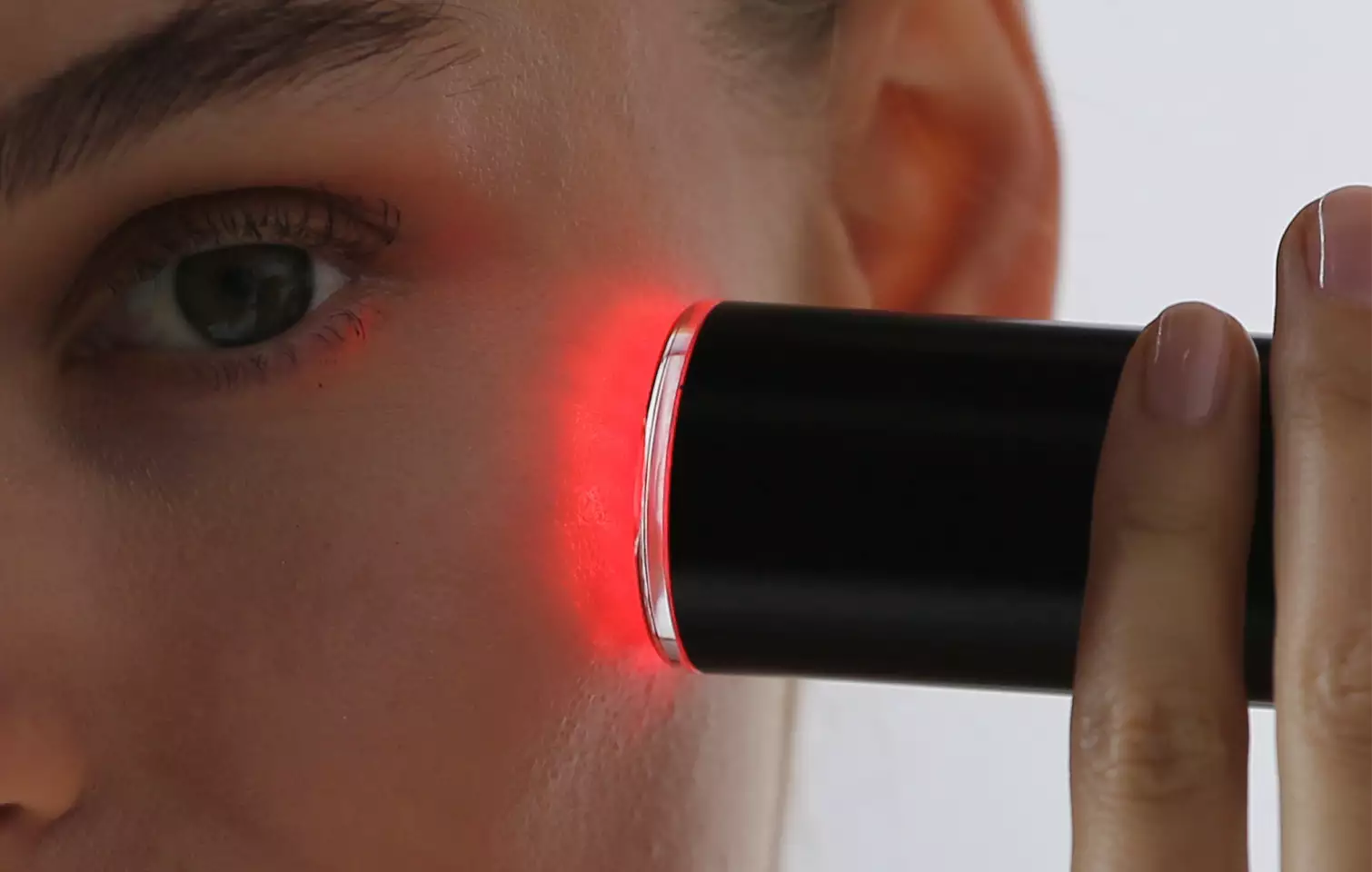
Low-level laser therapy has been studied since the late 1960s, when it was first used in medical settings to treat injuries. It was later developed for cosmetic use, as with the LYMA Laser. JOVS's marketing draws on the same science of photobiomodulation. The two devices differ in how each delivers it, and in how much independent evidence exists for each.
Coherent, single-beam light vs a distributed diode array
Laser light is defined by three properties: it is monochromatic (a single wavelength), coherent (its waves stay in a fixed phase relationship) and polarized. The LYMA Laser delivers all three in a single 808nm beam, with a consistent, calculable dose to the treatment area.
The JOVS mask uses laser diodes rather than LEDs, which sets it apart from most red light masks. Because it runs four wavelengths at once (660nm, 850nm, 940nm and 1064nm), the device as a whole is not monochromatic. JOVS's published specifications do not state polarization at the time of writing. Its energy is distributed across the whole face at once rather than concentrated on one area.
Results timeline: what to expect, and why 12 weeks matters
LYMA reports visible improvement from the first 30 days (tested on 28 women [cite study]), with full results building over 12 weeks of daily use. Many dermatology studies measure results at 12 weeks, one full skin cycle.
JOVS reports some changes from around 28 days. When comparing JOVS 4D Laser Mask before-and-after photos with LYMA results, check the time point and what was measured. Individual results vary.
Full-face convenience vs targeted precision
The JOVS 4D Mask is designed for hands-free, full-face use: you put it on and it treats the entire face at once. The LYMA Laser is designed to reduce the appearance of fine lines and wrinkles area by area, which takes more involvement per session and concentrates its power on the area being treated.
The JOVS mask covers the whole face, so it suits times when you are sitting or lying still. The LYMA Laser is handheld and cordless, so it can be used at your desk, while making dinner or on a call.
"Clinically tested" does not mean the same level of rigor for both devices. Independently peer-reviewed research and manufacturer-reported testing are different standards of evidence.
Comparing them through LYMA's P.O.W.E.R Index
LYMA's own P.O.W.E.R Index (Proven, Outcomes, Whole-system, Empowering, Return) judges whether a health investment is worth it. Applied to both devices:
Proven: LYMA has [five] peer-reviewed studies and an independent, instrument-measured clinical trial; JOVS has manufacturer-reported testing data.
Outcomes: LYMA's 103% increase in skin elasticity and 45-gene expression result are specific, measured results [cite]. JOVS reports an improvement timeline without peer-reviewed publication.
Whole-system: JOVS's hands-free design suits a lower-effort routine.
Empowering: LYMA's targeted, area-by-area format asks for more engagement and shows what is being treated.
Return: at [x] times the price [confirm US prices], the LYMA Laser earns its premium through a [lifespan: confirm] build and published research, over years of use. JOVS costs less and has less independent evidence.
Frequently asked questions about JOVS vs LYMA
Is the JOVS 4D Laser Mask more powerful than the LYMA Laser?
Per treatment area, no. JOVS reports higher irradiance than typical LED masks, with that output split across many diodes and four wavelengths over the whole face. The LYMA Laser concentrates its entire output through a single 1.24 sq in (8cm²) coherent lens onto one treatment area at a time.
Is the JOVS mask actually a laser, or is it an LED mask marketed as one?
JOVS's published specifications describe laser diodes at four wavelengths, which distinguishes it from standard LED masks and most red light therapy masks. It is a distributed array of smaller laser emitters in a wearable format, rather than a single-source coherent laser like the LYMA Laser.
Does the JOVS 4D Laser Mask actually work?
JOVS publishes its own before-and-after data and week-by-week improvement statistics.
At the time of writing, we could find no published, peer-reviewed clinical trial on the JOVS 4D Laser Mask. JOVS references third-party SGS testing, but we could not find the full study data published.
Is the JOVS mask safe for all skin types?
JOVS states its device is safe for regular use. With any higher-powered at-home device, people with sensitive skin or deeper skin tones (Fitzpatrick III–VI) should read the manufacturer's guidance before starting daily use.
How does treatment time compare?
The LYMA Laser requires a treatment time from 3 minutes per treatment area, daily. The JOVS mask is typically worn for 10–20 minutes per session, also daily, to cover the full face in one sitting.
Because the LYMA Laser treats one area at a time, it can be used on a single area, such as around the eyes or the mouth, rather than the full face every time. The JOVS mask treats the whole face in one pass.
Is the JOVS 4D Laser Mask worth it, or does the LYMA Laser offer better long-term value?
JOVS has a lower upfront cost. The LYMA Laser offers long-term value through independently published research, a build with an estimated lifespan of [lifespan: confirm, and match the P.O.W.E.R section], and a single, clinically studied wavelength and delivery method. Which is better value depends on whether you weight upfront cost or independent evidence more heavily.
What is the best at-home laser device for the face?
The best device is one with an FDA-cleared indication that matches your concern, published research and a format you will use daily. Both LYMA Lasers are FDA-cleared for the treatment of facial wrinkles. Read NIRA comparison too.
What features should I look for in an at-home laser for skin?
Look for true laser light rather than LED, a stated wavelength and power, an FDA-cleared indication, safe use around the eyes and a long warranty. Read about the Laser PRO technology.
Are laser masks better than handheld lasers?
Masks are convenient because they cover the whole face at once, while handheld devices focus energy on one area at a time. The right choice depends on whether you value convenience or targeted delivery. Read the truth about LED devices.
How much does a clinical-grade home laser device cost?
Premium at-home lasers typically cost from around $1,000 to over $5,000. At the time of writing, the LYMA Laser is $2,695 and the LYMA Laser PRO is $5,995, both with 0% financing. Read about financing options.
Which at-home skin devices are FDA-cleared?
Many LED masks, microcurrent devices and lasers have FDA clearance, but each for a specific indication. Check the FDA 510(k) database for the exact clearance. Both LYMA Lasers are cleared for the treatment of facial wrinkles. Read the NIRA comparison.
Medical research published on the science behind LYMA Laser and photobiomodulation
de Freitas, Lucas Freitas, and Michael R. Hamblin. "Proposed mechanisms of photobiomodulation or low-level light therapy," IEEE Journal of Selected Topics in Quantum Electronics 22.3 (2016): 348–364.
Glass, G. E. (2021). "Photobiomodulation: the clinical applications of low-level light therapy," Aesthetic Surgery Journal, 41(6), 723–738.
Keshri, Gaurav K., et al. "Photobiomodulation with pulsed and continuous wave near-infrared laser (810 nm, Al-Ga-As) augments dermal wound healing in immunosuppressed rats," PLoS One 11.11 (2016): e0166705.
Topaloglu, Nermin, Merve Özdemir, and Ziyşan Buse Yaralı Çevik. "Comparative analysis of the light parameters of red and near-infrared diode lasers to induce photobiomodulation on fibroblasts and keratinocytes," Photodermatology, Photoimmunology & Photomedicine 37.3 (2021): 253–262.
*This article compares publicly available specifications and independently published reviews as at 9th Oct 2026. Device specifications, pricing and promotional claims are subject to change by either manufacturer. Individual results vary.
Experience the difference
The LYMA Laser is backed by independent research, and is HSA/FSA eligible.


