

On the Save Yourself podcast, Dr Amy Shah, MD, and Lucy Goff break down the truth about skin collagen.
In a recent episode of the Save Yourself podcast, Dr Amy Shah MD sat down with Lucy Goff - founder of LYMA and the woman behind the first FDA-cleared at-home cold low-level laser therapy device - to ask a question that more women are beginning to ask: can you genuinely reverse skin aging without damaging your skin in the process? The conversation that followed is one of the most data-grounded and honest accounts of what the beauty industry has been getting wrong for decades.
Watch the full episode:
Who is Lucy Goff, and why does it matter?
Lucy Goff's route to founding LYMA is worth knowing. In 2012, she collapsed in a hair salon, went into labor with pre-eclampsia, and spent six weeks in intensive care recovering from septicemia. Her body, she says, was completely finished. It was in a clinic in Geneva that a physician introduced her to Professor Paul Clayton, a leading pharmacologist, who formulated a supplement using patented, peer-reviewed, clinically dosed ingredients. Within weeks she felt herself again - and that experience became the foundation of LYMA.
The LYMA Laser, which came later, was built on the same philosophy: find the science that actually works and build around it uncompromisingly.
Dr Amy Shah, a double board-certified physician and bestselling author of Hormone Havoc, brings that same standard to the Save Yourself podcast. She is not easily impressed, and she says so. What follows is what she learned.
Red light therapy vs laser technology - what the science says
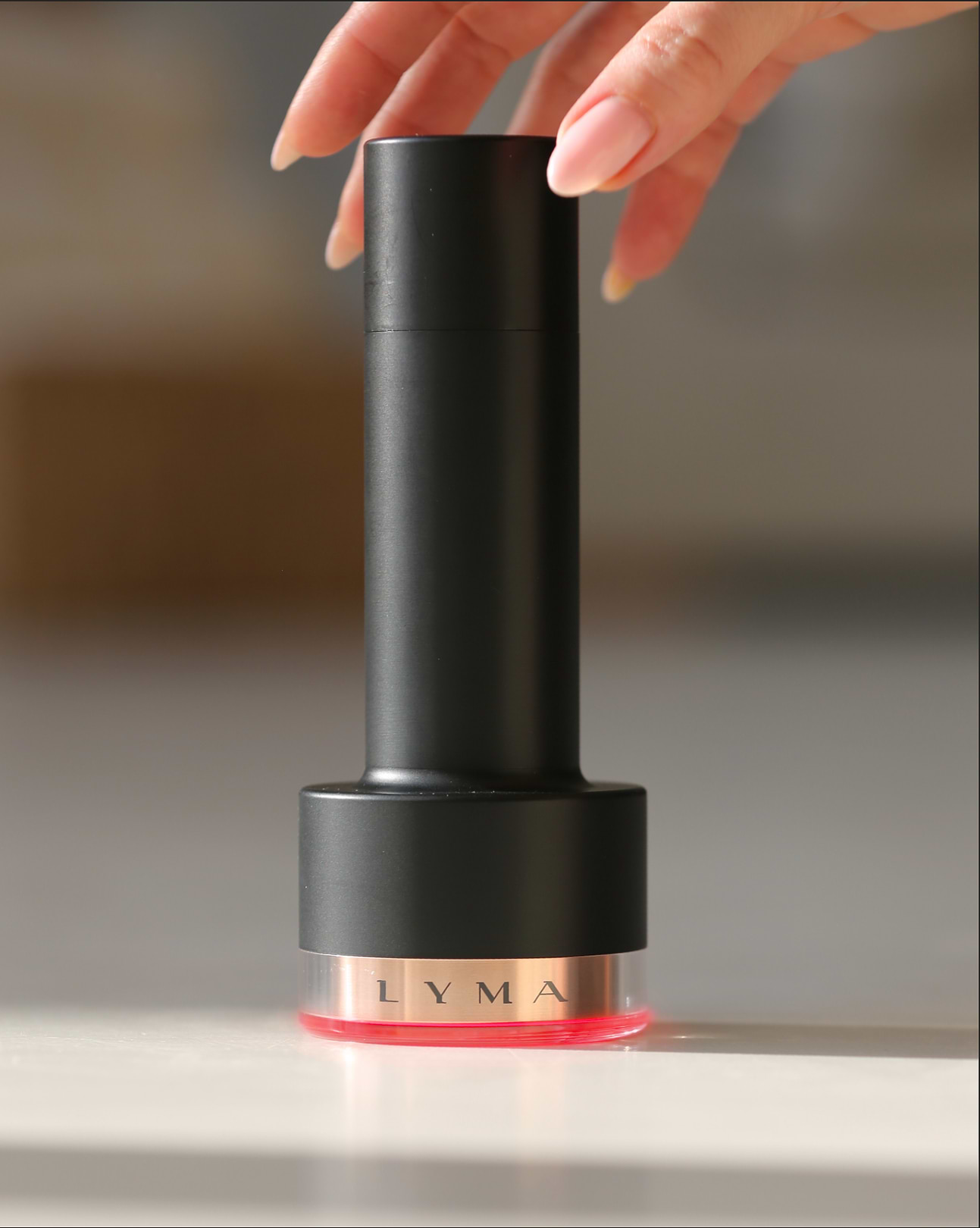
Dr Amy Shah opened the episode by saying what many women quietly think: she had the red light mask, she had the at-home devices, and she was not seeing the results the marketing promised. Lucy Goff's response reframes the entire category.
The core issue is physics. For light to have a biological effect inside the skin, it must have three specific properties: monochromatic (a single color), coherent (traveling in a straight line), and polarized (parallel). These three properties are exclusive to laser light. LED does not have them.
"LED is the bulb that's in the ceiling. It's a scattered light. When it hits a dense surface, it bounces off. And that's why when you put an LED mask on, you can see this really beautiful plume of light that comes from it. That's all the light that's not being absorbed into your skin."
Red light therapy stimulates the mitochondria through thermal heat and temporarily increases oxygenation - useful for a surface glow. But it cannot penetrate to the dermis, the deeper layer where collagen is actually produced. Lucy is candid on this point during the episode: red light has its place, but rebuilding or regenerating the skin is not within its biological reach.
In a clinical study published in Aesthetic Surgery Journal in 2025, the researchers built an equivalent device using LED as the light source - identical in power and frequency to the LYMA Laser, but with LED instead of laser light. They measured gene expression in the dermis of both types of devices. In the LED skin: one gene expressed. In the LYMA Laser skin: 45 genes expressed, including the SIRT1 longevity gene, which was accelerated six times.
What aging is actually doing beneath the surface of your skin
A significant portion of the podcast episode is devoted to the biology of skin aging - and it reframes why simply trying to boost collagen naturally through ingestion, or tighten skin with a surface-level device, falls short of the real problem.
Collagen production begins declining in the late twenties. The drop is significant: Lucy describes a 30% decline by your thirties. But collagen loss is a symptom, not the root cause. The cause operates at an epigenetic level - the cell itself stops functioning as it did when you were younger.
"Genes that should be upregulated that are associated with good things start to be downregulated. And genes that should be downregulated - associated with bad things - start to be upregulated. The cell doesn't function as it did when you were younger. And that's the reason why aging happens: because your body's ability to read your genetic masterboard declines."
The structure of the skin shifts in tandem. The dermis - the living, collagen-producing layer - thins. The epidermis, the more surface layer, thickens. That ratio moving in the wrong direction accelerates the visible signs of aging: lost density, sagging, textural change. No topical can reverse this, because it is happening several layers below where anything applied to the surface can reach.
What LYMA Laser does at a cellular level is switch the cell back into what Lucy calls youth mode - returning gene expression patterns to how they should function, prompting the skin to tighten and produce collagen naturally, rather than generating a repair response to an injury.
Why damaging the skin to stimulate collagen is the wrong approach

Traditional laser treatments - CO2, fractional, non-fractional - produce collagen by creating a controlled injury. The body's wound-healing response kicks in, and collagen is laid down as part of the repair. The problem, as Lucy explains in the episode, is that wound healing is not a precision process. It is a disordered emergency response, and the collagen it produces is in the same ratio as scar tissue.
She uses an analogy that reframes the argument entirely. If you asked a cardiac surgeon to micro-needle your heart - to damage the outside of it so it would heal and look better - no surgeon would agree. Your heart is an organ with a function. So is your skin. It is the body's largest organ and its primary barrier against pathogens. Injuring it, however controlled, is not a neutral act.
"The beauty industry for decades has damaged people and damaged skin in order to stimulate collagen production. And your skin is an organ - it's not there really to be damaged."
The LYMA Laser uses cold laser technology - a sensationless near-infrared laser that generates no thermal heat and causes no injury. The visible red glow on the device is simply an LED indicator; the near-infrared laser itself is invisible to the human eye. Three minutes per section delivers the exact dose required to trigger the epigenetic switch in the dermis. The device must be held still for those three minutes - not moved - to ensure the full dose lands correctly.
The laser light has a biological penetration depth of 9 centimeters - through skin, through muscle, into bone, without losing power. That depth is what makes it effective for areas that surface treatments cannot reach: jowls, neck, and inner arms, where visible sagging reflects not just skin laxity but the loss of muscle tone in the layers beneath.
"The skin is only as good as the muscle that it sits beneath. For areas like the jowls and the neck, you get a lift because it regenerates the muscle as well. So you get a tighter muscle, you get a tighter skin, you get a more youthful skin."
What Dr Amy Shah learned about using the LYMA Laser at home
One of the most useful parts of this podcast episode is Dr Amy Shah's candid account of her own experience with the device - including the mistakes she had been making. As a physician with limited time and healthy skepticism for overpromising beauty tech, her questions are exactly the ones most women would ask.
The at-home laser device requires no preparation products, works over makeup and SPF, and needs only an antibacterial wipe to clean. A timer signals when three minutes per section are complete. There are no goggles required - the 2023 FDA clearance covers use without them. The light will last ten years. A study on sun exposure also found that using the LYMA Laser before and after time outdoors prevents sun-induced brown spots and helps address UV-related skin damage.
The published research on longevity genes and skin
The clinical evidence discussed in the episode is where the conversation becomes most striking. The gene expression study published in Aesthetic Surgery Journal demonstrated that the SIRT1 gene was accelerated six times in human skin using the LYMA Laser. For context: a previous radiofrequency study had achieved SIRT1 acceleration of eight times, but only in a petri dish. When followed up in human skin, it produced no detectable effect. The LYMA result is in living human skin, confirmed by the Aesthetic Surgery Journal as a world first.
A follow-up clinical trial tested the device on diabetic patients with severe ulceration wounds following amputation. In the LYMA Laser group, average wound size reduced by 78% over four weeks. In the placebo laser group, wounds worsened.
"Anyone can do a private clinical study and say anything. The only thing that matters is independent published research. Go on PubMed. Ask AI to help you understand it."
The published science behind LYMA Laser is there to be read and interrogated. Lucy actively encourages it - which is itself a measure of how the evidence stands up.
"The only thing that matters is independent published research."
The full conversation between Dr Amy Shah MD and Lucy Goff is available on the Save Yourself podcast.
For more on skin health, longevity, and the science of aging well, explore the LYMA Journal.
You might also like


