

Inside Luke Storey's chat with LYMA founder Lucy Goff on The Life Stylist podcast.
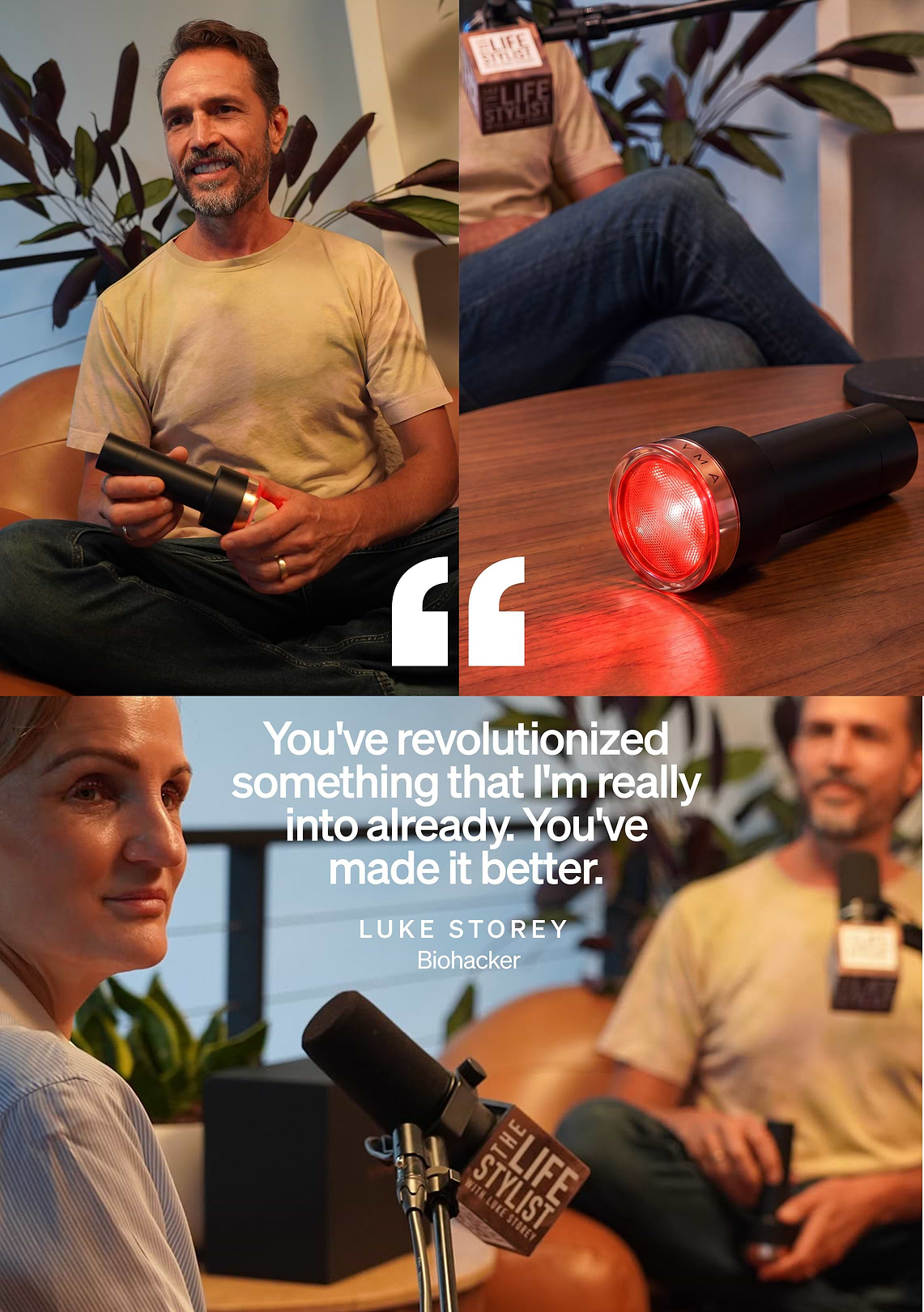
This LYMA Journal is based on a conversation between Lucy Goff, founder of LYMA, and biohacker Luke Storey, recorded for The Life Stylist podcast. Storey has spent over a decade testing lasers and light devices of every kind, and used the episode to dig into the science behind cold laser therapy and the LYMA Laser. Listen to the podcast below, and scroll down for the complete transcript.
Watch the full episode: The Life Stylist podcast episode with Lucy Goff
LED vs cold laser therapy: why depth matters
Most light therapy devices on the market use LED. It's affordable, it's widely trusted, and it makes a room glow - but it can't reach very far. LED light scatters the moment it meets skin, a little like trying to push a feather through fabric. Laser light behaves differently: coherent, monochromatic and polarized, it travels in a straight line, like a needle, allowing it to move beneath the surface rather than bouncing back off it.
Depth is what changes the outcome
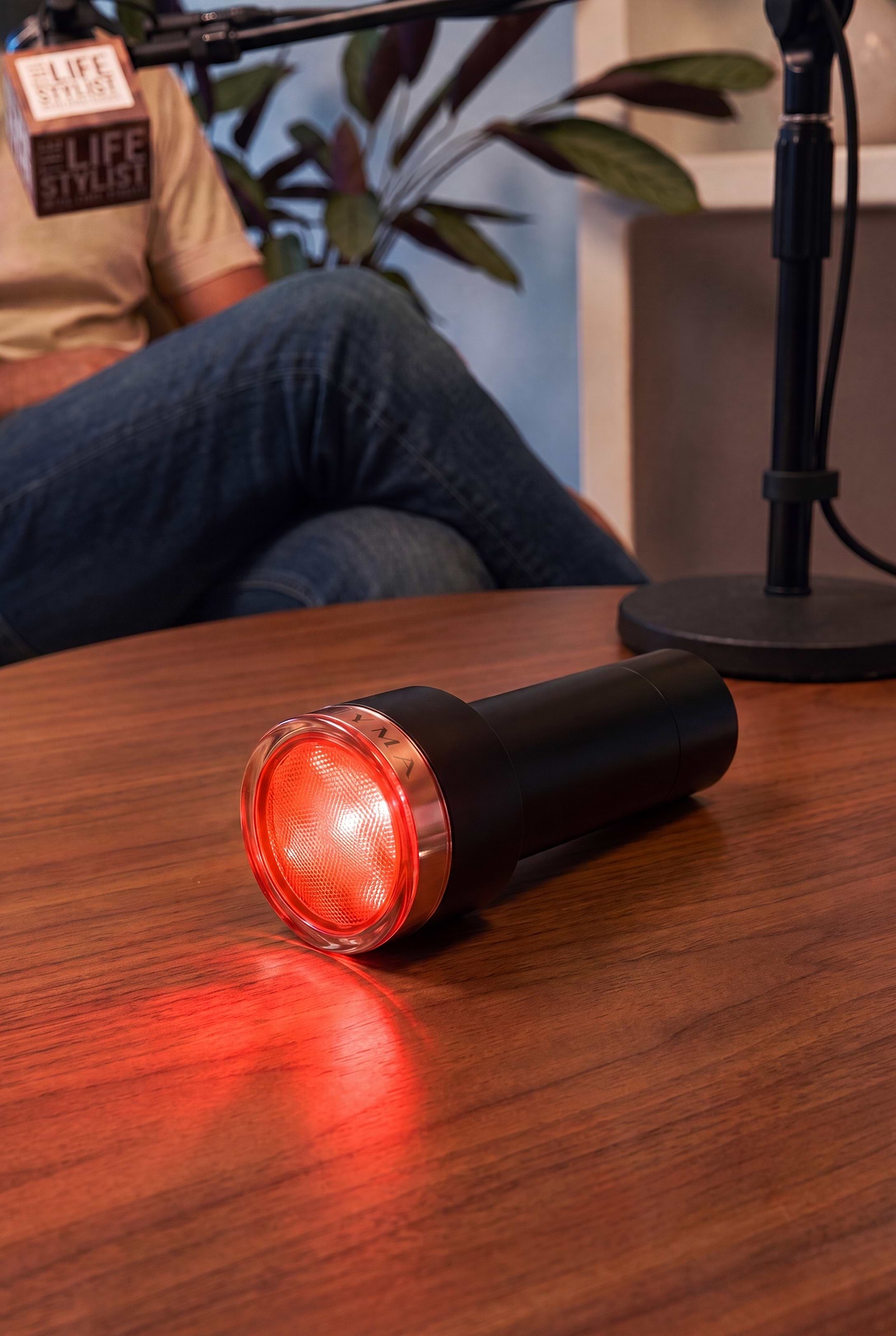
This distinction is what stood out to Storey. The LYMA Laser PRO is FDA-cleared to treat the appearance of wrinkles on the face, using a patented optical diffuse lens to spread concentrated, coherent laser light evenly across a wide treatment area while still reaching beneath the skin's surface. That depth is what allows it to support the skin's own collagen production at a level LED light simply doesn't reach. Read more on the science behind LYMA.
Backed by clinical research
It's unusual for a beauty device to carry this level of clinical scrutiny. Getting the LYMA Laser's original FDA clearance was, by Goff's own account on the podcast, an exacting process, and LYMA has continued to run studies since. A world-first clinical study comparing the skin's response to the LYMA Laser against an LED device of the same wavelength and power was published in the Aesthetic Surgery Journal, and every unit goes through extensive durability testing, with diodes engineered to last up to a decade. It's the kind of rigor more commonly associated with medical devices than at home beauty tools.
The question everyone asks: is it safe around the eyes?
It's one of the most common questions LYMA hears, and a fair one to ask. The skin around the eyes is the thinnest on the body, and most laser devices come with protection goggles for good reason. It's still sensible not to stare directly into the light, but the eye area itself can be treated with confidence - something many first-time users are surprised to learn.
"This is really new. It's like category defining."
Luke Storey, The Life Stylist
What that means for your face, day to day
On the podcast, Storey and Goff discussed where people typically notice a difference first: the jawline and neck, and fine lines around the eyes and mouth. Used consistently, the treatment is designed to support smoother, more youthful-looking skin over time. As with any skincare routine, individual results vary.
Storey is no stranger to laser and light therapy generally - he's used various handheld cold laser devices for years, including, by his own account on the podcast, on his dog after surgery. What stood out to him about the LYMA Laser specifically was the engineering: a treatment lens wide enough to cover a whole area in three minutes, rather than the narrow beam of the smaller devices he already owned.
"You can really see the contrast."
A different way to treat your skin at home
For a limited time, the LYMA Laser PRO can be financed from $249.79/month over up to 24 months with interest-free financing from Affirm, and is HSA/FSA eligible. Watch the full episode to hear Storey's conversation with Lucy Goff, and browse the LYMA Journal for more on the science and the stories behind it.
Hear Luke Storey and Lucy Goff in conversation on The Life Stylist podcast, and discover the LYMA Laser PRO for yourself.
Full episode transcript
[00:01:05] Luke Storey: All right, tell me about the health crisis that, uh, led to a career pivot.
[00:01:09] Lucy Goff: Well, it was a bit of a crisis. Um, I certainly didn't expect it. I, I was in the hairdresser's actually, as you are, eight months pregnant, and I was having my hair color done, 'cause I thought, oh, you know, like, let's look really good for the birthing pictures.
[00:01:31] Lucy Goff: And I actually went into, went into labor in the hairdresser's.
[00:01:35] Luke Storey: Are you serious?
[00:01:36] Lucy Goff: Yeah. Went into labor. Wow. And I just thought, "I can't even wait till the end of this appointment." I could just feel like a rush of something going through me, and I didn't know what it was. Um, and the hairdresser's was opposite the road from the hospital where I was due to have my daughter, and the only thing I remember was walking into the foyer and I collapsed.
[00:01:59] Lucy Goff: [00:02:00] And then I woke up on the operating table, and, they t- had told me that I've got a severe form of preeclampsia, and they had to get the baby out there and then. One thing led to another, and I, well, f- a few days later, I was back in hospital with septicemia- Oh,
[00:02:21] Luke Storey: wow ...
[00:02:22] Lucy Goff: where I stayed for a few weeks- like six weeks while they were battling to find the, a drug that would get rid of the, of, of, of the, of, of the bacteria.
[00:02:35] Lucy Goff: Um, and it was through my recovery when I went to Geneva to one of these clinics to, for, so they could look at my bloods and see what was going on, because, you know, like, I couldn't hold my baby. I couldn't stand up. My, all my body was shaking. Um, and I'd gone back to all these physicians and said, "You know, can you not give me
[00:03:00] something to, to help me?"
[00:03:02] Lucy Goff: And they were saying, "Well, look, the infection's gone. There's nothing I can do. You know, just give it time. You'll be fine." I just thought, "Well, I haven't got time, 'cause I can't live." Um, and it was in Geneva that I bumped into one of the world's leading longevity professors, a guy called Professor Paul Clayton, and he introduced me to, uh, the, some in- pharma- to, well, to basically the pharmaceutical equivalent of a supplement drug.
[00:03:31] Lucy Goff: Um, you know, patented, peer-reviewed ingredients that were, proven in published studies to look at the- relationship between sleep and stress, which he said was my problem. Um, if you can't sleep, you're stressed. If you're stressed, you can't sleep. And these were 10 powerful ingredients and literally, like a few weeks later, I felt myself again.
[00:03:59] Lucy Goff: Really? [00:04:00] And I went into business with him. He was the guy that I went into business with- Oh ... at LYMA. So it, it all worked- Let's
[00:04:06] Luke Storey: make business out of this 'cause it worked?
[00:04:07] Lucy Goff: Well, I think I was so desperate to get more of these ingredients, and it started off, I was just like, you know, I was thinking, well, if I, you know, if I...
[00:04:16] Lucy Goff: 'Cause these ingredients were not available in shops at the time. They were like the hidden category of the, of the supplement world. Um, and I thought, well, if I, if I offer to go into business with him, maybe he'd sell me more of them. Um, so yeah, it was, it was a joke that we've always had this joke that, you know, I set up LYMA for, you know, kind of for the wrong reasons.
[00:04:40] Lucy Goff: But ultimately, I did set up LYMA to change people's lives, through our supplement, which we first launched with, which we, was, you know, we, we, we still retail today, uh, which is, still the same formula that I took all these years ago. Oh,
[00:04:57] Luke Storey: I didn't realize that. Yeah.
[00:04:58] Lucy Goff: Yeah.
[00:04:58] Luke Storey: Is that on the same website [00:05:00] as the LYMA Laser?
[00:05:00] Lucy Goff: Yeah. Yeah.
[00:05:01] Luke Storey: Oh, wow, didn't even mi- I think I was so zeroed in on LYMA Star- So zeroed
[00:05:05] Lucy Goff: in to laser ...
[00:05:05] Luke Storey: just fast right over it.
[00:05:06] Lucy Goff: And then obviously the LYMA Laser, which is the iconic, invention that, has changed- Tens of thousands of people's lives-
[00:05:20] Luke Storey: Including two that live in this house-
[00:05:22] Lucy Goff: Including yeah ... as we- You and your wife
[00:05:25] Luke Storey: With the, with the supplement, I'm fascinated by this because, you know, I've got a cupboard full of them.
[00:05:29] Luke Storey: Of course, I've been, you know, ta- I think I've started taking vitamins when I was about five or six. My mom used to- Oh ... buy this. So I'm a OG in the supplement space, and, you know, some work better than others, but it's rare that, it's rare that I find, you know, one particular formulation that, that has a really meaningful, effect.
[00:05:52] Luke Storey: You know, if somebody's really struggling like you were, there's not very many supplements you can go, "Oh, take this," and there's a night and day change. You know, they're kind
[00:05:59] Lucy Goff: of- No ...
[00:05:59] Luke Storey: they're [00:06:00] gradual and subtle, and some of them, you know, some of them definitely have a compound effect, but it's not something usually that you see like, "Whoa, this is incredible."
[00:06:08] Lucy Goff: Yeah, you don't see something the day after because there's no stimulances and, and there's no sedatives in. But if you take them religiously every day for 12 weeks, you- and then you come off them, I always say come off them after 12 weeks and then you'll see the difference, you know? And, and that's why we, we introduced a, a pause facility on the, on the supplements so people could stop taking them or try something else and then come back to them.
[00:06:37] Luke Storey: I'm gonna try it out.
[00:06:38] Lucy Goff: Yeah.
[00:06:38] Luke Storey: I've just-
[00:06:39] Lucy Goff: 12
[00:06:39] Luke Storey: weeks ... just when I, just when I thought I've tried every supplement- ... in the world. But yeah, sometimes it's difficult for me because I'm, I'm trying so many new things all the time. It's just, it- it's, it's kind of my hobby and passion and also part of my job here. And so it's, it's difficult because people say, "Oh, what did you notice?"
[00:06:54] Luke Storey: You know. "How are you enjoying it?" What do you take? It's like-
[00:06:56] Lucy Goff: Everything, I guess.
[00:06:57] Luke Storey: I mean, yeah, just all the technologies, [00:07:00] saunas, ice baths, all kinds of lasers, light devices. I mean, just crazy amount of stuff in this house. Um, but it's difficult for me to do isolated experiments, right? Where I'm like, "Okay, I'm just gonna-" I'm
[00:07:10] Lucy Goff: not gonna do anything else.
[00:07:11] Luke Storey: Yeah, I'm just gonna- I'm now I'm gonna do this ... drink water. Yeah. Eat normal food. Yeah. Take a month, just that, and then introduce a supplement or a laser or whatever it is- Yeah,
[00:07:19] Lucy Goff: laser ...
[00:07:19] Luke Storey: and see what happens. So I'm not a very good test subject, because I'm just doing everything all the time. But I can t- I can generally tell if something does nothing, but I can't really tell sometimes if it's an- No, you can-
[00:07:32] Luke Storey: exponential-
[00:07:32] Lucy Goff: Yeah ...
[00:07:33] Luke Storey: positive effect.
[00:07:33] Lucy Goff: No, this supplement is very good. It looks at the symbiotic relationship between sleep, skin, and stress. So, you know, if you don't sleep, your skin suffers. If you are stressed, you don't sleep, and then your skin suff- so it's kind of like looking at the relationship between those three issues that you can't treat in isolation.
[00:07:56] Lucy Goff: But again, using non-organic ingredients. These are [00:08:00] ingredients that have been like, you know, they've infused with high-tech delivery systems to, make sure that they're bioavailable, uh, that they're stable in your body, uh, that there's no toxicity, that they survive the acid in your stomach, uh, that they can be uploaded into your plasma, what the dosage should be.
[00:08:20] Lucy Goff: Uh, they've been tested in preclinical and clinical trials, so, it's an amazing formulation. Well, it changed my life.
[00:08:28] Luke Storey: Awesome. Uh, going back to the issue you had in birth and the six weeks you spent in the hospital after that, were you able to have your baby with you while you were in recovery?
[00:08:40] Lucy Goff: No. No.
[00:08:42] Luke Storey: Oh,
[00:08:42] Lucy Goff: man.
[00:08:42] Lucy Goff: She wasn't allowed in the ward.
[00:08:44] Luke Storey: Wow.
[00:08:44] Lucy Goff: No, that was really tough. I've never felt so desperate in my life. Um, you know, like, I'd waited so long to have her.
[00:08:52] Luke Storey: Yeah.
[00:08:53] Lucy Goff: Um, I was 39. I'd waited all those years to have her, and then I, I was away from her for four weeks.
[00:08:59] Luke Storey: [00:09:00] Wow.
[00:09:00] Lucy Goff: The last two weeks, I was, went onto a different ward, and she was a- she was allowed to come on, but there were not allowed baby...
[00:09:07] Lucy Goff: 'Cause it was an infectious, it was, it was a ward that they didn't a- allow, well, certainly newborn babies on.
[00:09:16] Luke Storey: Yeah, yeah. And then am, am I, uh, correct in that you had another baby 10 years later- ... at 49?
[00:09:23] Lucy Goff: Well, I think the first one was so traumatic, like, I was thinking, "Can I really go through this again?"
[00:09:30] Luke Storey: Yeah.
[00:09:30] Lucy Goff: Uh, and I left it so long, and then I thought, "Well, I've left it too late." And, I was 47, and, uh, then I was thinking, you know, "Well, I think I've left it too late now." And I went to the doctor's, uh, just to see whether I had. Obviously, you know, I don't think, uh, anyone or very, I, I don't know anyone that would get pregnant naturally at 47.
[00:09:57] Lucy Goff: Um, but when I went to, I went to be [00:10:00] tested, they said that you still have, uh, you still have eggs, so. It was a true miracle, though, because I went through IVF, and- I, they retrieved a, a very, it was a very few number of eggs, and they, they made, uh, it was, you know, they then make it into an em- they, they make them into an embryo.
[00:10:26] Lucy Goff: And there was one embryo that was okay to be put back- One viable one. Wow. One viable one. Wow. So there was three in total, but the other two, I had them tested, for chromosomal abnormalities.
[00:10:39] Luke Storey: Yeah.
[00:10:40] Lucy Goff: And it came back that they were non-viable, so there was one.
[00:10:44] Luke Storey: Wow.
[00:10:44] Lucy Goff: And they said, "Well, look, you know, we're putting this one back.
[00:10:48] Lucy Goff: Really, the likelihood is it's not gonna work. We just want to set your expectation." Um, and I always thought, you know, at least I tried. Whatever happens, you know, at least I've tried. I [00:11:00] think the worst thing that you can do is look back on something and just live off regret.
[00:11:05] Luke Storey: Yeah.
[00:11:05] Lucy Goff: Uh, very rarely you will feel, regret at trying.
[00:11:11] Lucy Goff: So they put it back. I went for, acupuncture. It helps with the, the blood flow. And I know it's funny, but I could feel at the time, there was something in me that was saying, "Lucy, I think it's gonna work." Um, and it did.
[00:11:27] Luke Storey: Incredible.
[00:11:28] Lucy Goff: And actually, that was a lot, was a, an easier pregnancy than the other one, and I was like, at the time I had him when I was 49.
[00:11:36] Luke Storey: Wow, so cool.
[00:11:38] Lucy Goff: So yeah.
[00:11:39] Luke Storey: Yeah, I agree. Better to have tried. I mean, we tried and we, we gave it everything we got. I mean, you know, there's always room for miracles still, but, you know, had, I think had we not, uh, you know, given it a real fair shot, you know, you're gonna be 80 years old going, "Ah, maybe it would've worked," you know?
[00:11:57] Lucy Goff: Yeah.
[00:11:57] Luke Storey: It's like you gotta at least try.
[00:11:59] Lucy Goff: Yeah.
[00:11:59] Luke Storey: [00:12:00] Uh, let's, let's talk about, the effect of light on biology. You know, I gave you a tour of some of my few, you know, lasers and things like that. I mean, your
[00:12:09] Lucy Goff: bedroom is, is loaded. I've never seen a bedroom like that.
[00:12:12] Luke Storey: Unfortunately, our bedroom is like a medical clinic at the moment.
[00:12:14] Luke Storey: It
[00:12:14] Lucy Goff: is, it is
[00:12:15] Luke Storey: a bit of medical clinic. Ran out of room for all this stuff. Um, but yeah, I've, you know,
[00:12:19] Lucy Goff: I've been- No, it's very cool. Most people just have like a vanity unit.
[00:12:22] Luke Storey: Hey, you know, it's not that pretty, but it's nice to be able to lay in bed and get your treatments. Um, so yeah, so I've been using lasers, uh, for, oh, I don't know, God, probably- 10 years or so.
[00:12:35] Luke Storey: I was telling Russ, uh, where he was asking how old our dog Cookie was, and when I adopted her, she had been spayed, so I had to pick her up from the, from the vet, from the hospital. And I never owned a pet be- or never owned a dog before. I'd had cats when I was little, and she had these huge, you know, uh, wounds from the surgery, stitches and all that.
[00:12:55] Luke Storey: And so I, I got one of my handheld lasers- Yeah,
[00:12:57] Lucy Goff: it's quite big. I, I remember my dog is quite [00:13:00] small- Yeah ... and the w- wound was unnecessarily big.
[00:13:02] Luke Storey: Yeah, it's crazy. Yeah. She was in really bad shape and very unhappy about the whole ordeal. So I started using my laser on her, and it healed in, like, a week. Yeah. It was supposed to be six weeks.
[00:13:12] Luke Storey: Yeah. You know, they're like, "Oh, don't let her walk around." Yeah. You know, "You're still gonna see," and it was like this- Yeah ... it sealed it right up. Yeah. And I was like, "Okay, I'm sold. This is
[00:13:19] Lucy Goff: amazing." No, it's very, very good. Yeah. Because obviously laser has got a deep penetration, and when you have surgery, it's, you know, they s- often they don't just go through the skin.
[00:13:29] Lucy Goff: They go through muscle, and they might even go into an organ. So it's important that you can be able not just to heal your skin, but all the tissue that goes beneath it as well.
[00:13:39] Luke Storey: Right. Right. So we know, uh, you know, we've got full spectrum sunlight that's got all the colors of the rainbow, including, you know, obviously the spectrum within the red that you can see and the red that you can't see.
[00:13:53] Luke Storey: Uh, I get a lot of sun. I love it. I, you know, I'm out naked in the yard as much as I can at solar noon. People [00:14:00] tell me I'm crazy. I'm 55. I don't have too many wrinkles. Uh, I must be doing something right. Uh, so I'm, I'm a huge proponent of the sun,
[00:14:08] Lucy Goff: but the- I am too. Uh, lots of people are afraid of the sun.
[00:14:10] Luke Storey: Well, we've been conditioned and brainwashed that the sun is gonna give you cancer. Meanwhile, the highest cancer rates are amongst shift workers who get no sun but a lot of blue light. So there you go.
[00:14:20] Lucy Goff: Maybe there's something to do with
[00:14:21] Luke Storey: that. But yeah, but point being, you can only get so much sun, and unless you have a magnifying glass that's gonna burn a hole in you, you can't really concentrate, you know, the, the light from the sun.
[00:14:32] Luke Storey: Uh, you just kind of have to go outside, and you get what you get, right? So w- what brought you into the realm of lasers and, and using light in a more concentrated and specific way in terms of healing?
[00:14:46] Lucy Goff: It was an accident Um, Professor Clayton, who I went into business with, uh, he was in Germany and it was just before lockdown.
[00:14:58] Lucy Goff: It was just before COVID, [00:15:00] and he was looking at a man's knees that had been treated with low-level laser therapy, so cold laser technology, to rebuild cartilage in one of his knees. And there was this whole team of doctors, and they were all at one end of the room, and they were all looking at the X-ray of the cartilage increase over a 12-week period.
[00:15:21] Lucy Goff: And he, he's always very curious. He was at the other end of the room, and he was looking at the skin, the photograph of the skin on the knee that had been treated. And the guy, the, the patient was in his early 60s, and the-- he noticed that the skin on the knee that had been treated looked about 20 years younger than the skin on his other knee.
And he was looking at this huge floor-standing cold laser machine that he was, that, that the guy had been treated with. And it was then that he looks up at the ceiling and he realized that the entire light device industry was really focused on [00:16:00] LED It's just the light that's in the ceiling, which is amazing at lighting a room, but it's got no biological poten- it's got no biological penetration.
So like, and if we could re-engineer this huge floor-standing hospital machine into a little portable device at the same power with a bigger treatment lens that was portable that you could take with you, that people could use it at home, 'cause really, it's a... this cold laser is a technology that you do need to use every day, and it's not practical for people to go to a hospital or to, to pr- to a professional place to have it done.
And he figured if we could find, like, a really incredible team to re-engineer this big hospital machine into a little device, then we could change the industry forever, and, that's what we did. And as it happens, he knew, of an [00:17:00] incredible laser professor in Europe whose father had invented the helium laser.
So like, he was, like, in the... If you're ever gonna go to, like, a, a laser family, like, this was the one. And the guy was mortified that we were using... that we were gonna create, products for skin because obviously this technology has got thousands of published papers, for y- like, wound healing, for Alzheimer's, for pain, for, nerve damage.
[00:17:38] Lucy Goff: You know, there's, like, so much published research out there on near-infrared light at 808 nanometers, and he just could not believe that we were using it for skin. Um, but we, you know, we created this device, and- [00:18:00] It was actually a quicker process than, than we, than we thought it was gonna be.
[00:18:04] Lucy Goff: I was thinking, well, it's gonna take, like, 10 years or something. That's what I would think. Um, but I think, you know, when fundamentally the, the clever part of this device is actually the lens. So it's got, a, a patented optical diffuse lens technology inside of here, and that's why it's better than every other cold laser machine out there 'cause, you know, the machine that you were using out there that I was explaining, you know, with cold laser machines you tend to only get the treatment area where the little diode is.
Um, so obviously like, a laser beam is like, is thinner than a strand of hair, so you get a very small treatment area. But with this optical diffuse lens that we've now patented, for the first time you, you get, like, an equal light distribution amongst the whole lens, [00:19:00] so you can treat, like, 33 centimeters, of, of, of, of this lens, you know, whether it's on your knee to reduce pain or, you know, your neck to make it look younger or your jowls to make it look younger or your inner arm or, you know, you can put it anywhere on your body.
And we use 808 nanometers because it's got the most evidence for regeneration, and this is the, the, the wavelength where you get laser speckle. And laser speckle is what's different to, near-infrared cold laser light and near-infrared LED light. So with LED, you don't get the laser speckle, and it's the laser speckle that actually, produces the regeneration in deep tissue Um, which I never knew anything about this before I was immersed with [00:20:00] these incredible laser professors.
[00:20:02] Lucy Goff: Um, but I think, you know, there's so many people that stand in front of these red light panels, that have these red light masks. The, the way one of the laser professors described it to me always stayed with me. I said, "You know, they, they look so dramatic. They look so beautiful. You know, you can see the light coming out of it."
And he said, "Well, the fact that you can see the light coming out of it is the very problem." He said, "'Cause every single bit of light that you see with your human eye is light that has not gone into the body. It's not been absorbed by the skin. It's bounced off the surface of the skin, and it's gone back into the room."
Because LED cannot penetrate into your skin. It's a scattered light. It's like, it's a wavy light. If, if you looked at a laser beam, it's like a needle. It's like a, a, a needle. But an, an LED is like, a wavy line. It [00:21:00] scatters all over. It's a line that goes in a wave, and when it hits a dense surface like the skin, it can't penetrate through.
It's like trying to push a feather through your skin. It would never push through. Whereas if you, uh, try to push a needle through your skin, it'd pierce all the way through. Um, and actually, he was explaining that for a light to be able to penetrate into your skin, it's got to have three properties. It's got to be coherent, which means it's in a straight line.
It's got to be monochromatic, which means it's one color, and it's got to be polarized, which means it runs in tramlines, and that is exclusive to laser light, not LED. LED is obviously this lovely, scattered, wavy line. Uh, it runs off in all different directions, so it's never, polarized, and it's always mixed with white, so it's never [00:22:00] monochromatic.
Um, so yeah, it's, it's, it's been an interesting biological learning for me. Um- Because I, I never knew any of this before I started laser-
[00:22:15] Luke Storey: It sounds like you're getting up to speed pretty quick.
[00:22:17] Lucy Goff: Yeah. Well,
[00:22:18] Luke Storey: it's interesting. To, to your point of the, you know, of the minuscule surface area that a laser covers, even some of the really expensive ones, like I have some handheld ones by a company called Power Medic, that's what I used on Cookie, and it's great for small areas, right?
And it w- you know, there's one that's really good for cuts, but you know, it's like-
[00:22:39] Lucy Goff: It's very, very
[00:22:40] Luke Storey: small ... you know, it's tiny, so you, you couldn't- It's
[00:22:41] Lucy Goff: very, very small ... you couldn't
[00:22:42] Luke Storey: treat, like, a big area with it, you know? And
[00:22:43] Lucy Goff: it's interesting 'cause I was speaking to, an orthopedic surgeon, and he was explaining for, uh, joint pain, they really don't serve it because, you know, look at the surface area of a joint.
It's like, you know, obviously you've got one joint, you've got the other, but it's kind of like a whole surface area that you need to treat if you've got inflammation in the bone or in the muscle. And that's why this is so brilliant, because you can cover the entire area in three minutes. You know, you'd be there a long time with, uh, with a smaller laser.


